
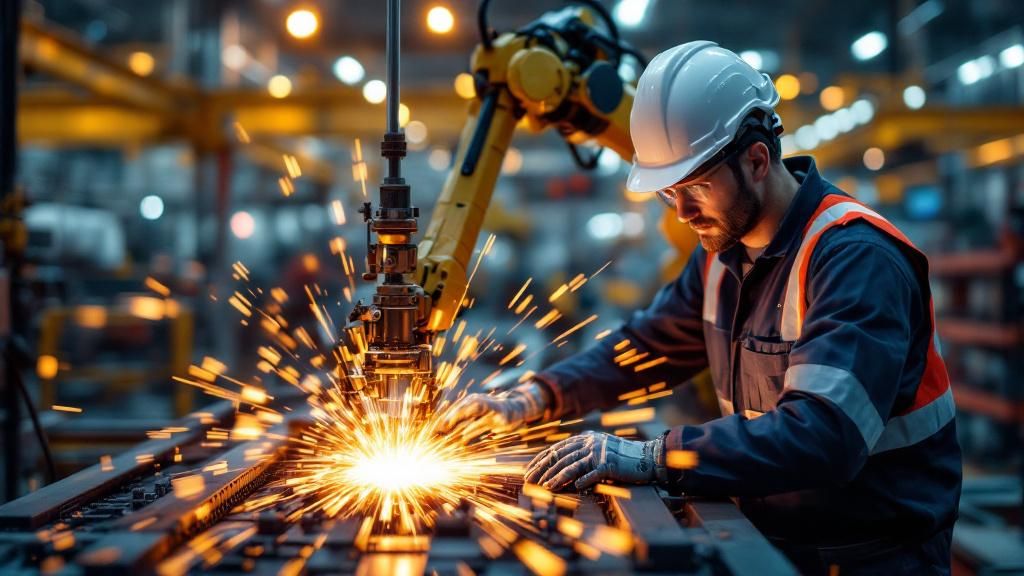
The UK manufacturing sector is experiencing an remarkable transformation as business leaders allocate record-breaking investments in next-generation automation solutions and comprehensive workforce development programmes. This strategic shift demonstrates manufacturers’ commitment to enhance productivity, remain globally competitive, and secure their economic future. Our research demonstrates the substantial financial commitments propelling this manufacturing transformation, explores the innovative technologies revolutionising factory floors, and evaluates how businesses are preparing their workforce for future requirements. Discover what this investment surge means for British manufacturing’s trajectory.
Growth Surge in Automated Systems
The UK manufacturing sector has seen an substantial financial dedication towards automation technology, with spending hitting record highs in recent times. Major manufacturers across automotive, aerospace, and electronics sectors are committing significant funds towards automation robots, AI technology, and cutting-edge production methods. This capital boost reflects industry confidence in automation’s ability to improve production efficiency, cut production expenditure, and raise quality benchmarks. The extent of this investment emphasises manufacturers’ recognition that technological advancement is essential for maintaining competitive advantage in an increasingly global marketplace.
Industry experts ascribe this capital flow to various overlapping factors, encompassing post-pandemic distribution network evaluation, increasing employment expenditure, and the critical requirement for greater manufacturing agility. Companies are prioritising automation solutions that offer flexibility and scalability, enabling swift adjustment to fluctuating market demands. Investment statistics demonstrate that manufacturers are not merely replacing manual processes but fundamentally reimagining operational frameworks. This planned method guarantees that British manufacturing stays at the leading edge of manufacturing advancement, establishing the sector for sustainable growth and improved durability against forthcoming financial volatility.
Strategic Staff Development Schemes
Recognising that technological advancement alone cannot drive success, UK manufacturers are allocating considerable funds in broad-based skills development schemes. These initiatives constitute a fundamental shift in how the industry values and nurtures human capital. By pairing automation deployment with robust training schemes, manufacturers are confirming their workforce can effectively operate, maintain, and optimise new technologies. This comprehensive strategy resolves competency deficiencies whilst enhancing worker confidence and involvement in an rapidly mechanised environment.
Competency Development Initiatives
Leading suppliers have established custom training centres and apprenticeship schemes intended to provide workers with critical digital and technical skills. These schemes include robotic systems operation, data analytics, information security, and advanced programming languages. Investment in classroom-based and digital learning solutions provides availability throughout all employee tiers. Companies are partnering with educational partners to provide qualifications recognised across the industry, enhancing career development potential and staff retention levels considerably.
The financial commitment to skills training extends beyond first-stage induction, with organisations deploying sustained professional growth programmes. Workers receive regular upskilling prospects to respond to evolving technological environments and developing professional benchmarks. Many employers make available training subsidies, mentoring schemes, and sabbatical leave for continued learning. This continuous dedication reflects companies’ dedication to developing sustained career pathways and building a environment of ongoing education within their companies.
Collaboration with Learning Establishments
UK manufacturers are forging strategic partnerships with universities and further education colleges to synchronise course design with industry requirements. These partnerships ensure graduates possess practical skills immediately applicable to modern manufacturing environments. Joint ventures include curriculum design, guest lecturing, laboratory access, and equipment provision. By engaging directly with academic organisations, manufacturers influence the pipeline of talent entering the sector, addressing anticipated skills shortages in advance.
Additionally, manufacturers sponsor research initiatives and innovation hubs within academic institutions, fostering knowledge exchange and technological progress. Double-degree programmes and industrial placements provide students with invaluable real-world experience whilst providing companies first access to emerging talent. These working relationships reinforce the UK’s status as a international manufacturing leader, maintaining long-term competitiveness and establishing Britain as an appealing destination for high-tech manufacturing investment and talent development.
Economic Impact and Future Outlook
The historic investment in automation and employee development is expected to deliver considerable financial gains across the UK manufacturing landscape. Market experts anticipate output increases of up to 25% over the next three years, resulting in greater output and enhanced competitiveness in international markets. These developments are expected to generate approximately 15,000 fresh skilled manufacturing roles whilst strengthening Britain’s role as a technology-led manufacturing centre. The broader economic effect of this investment will likely drive expansion throughout supply networks and allied industries.
Long-term prospects for UK manufacturing appear increasingly optimistic as businesses establish themselves at the leading edge of Industry 4.0 adoption. Companies committing to automation today are preparing themselves to capture emerging market opportunities and respond swiftly to evolving consumer demands. The combination of artificial intelligence, robotics, and sophisticated data analysis promises to unlock innovation potential previously constrained by labour availability and practical restrictions. Forward-thinking manufacturers recognise that lasting competitive advantage depends upon relentless innovation progress and staff capability building.
Looking ahead, the drive created through present investment movements suggests a substantial transformation of UK manufacturing’s economic impact. State backing through workforce development funding and commercial incentives will potentially speed up adoption across SMEs. As automation develops and worker capabilities increase, UK manufacturers are poised to regain market share from overseas competitors. This transformation constitutes not simply industrial upgrade but a strategic repositioning of manufacturing as a foundation of Britain’s forthcoming economic prosperity and technology leadership.
